
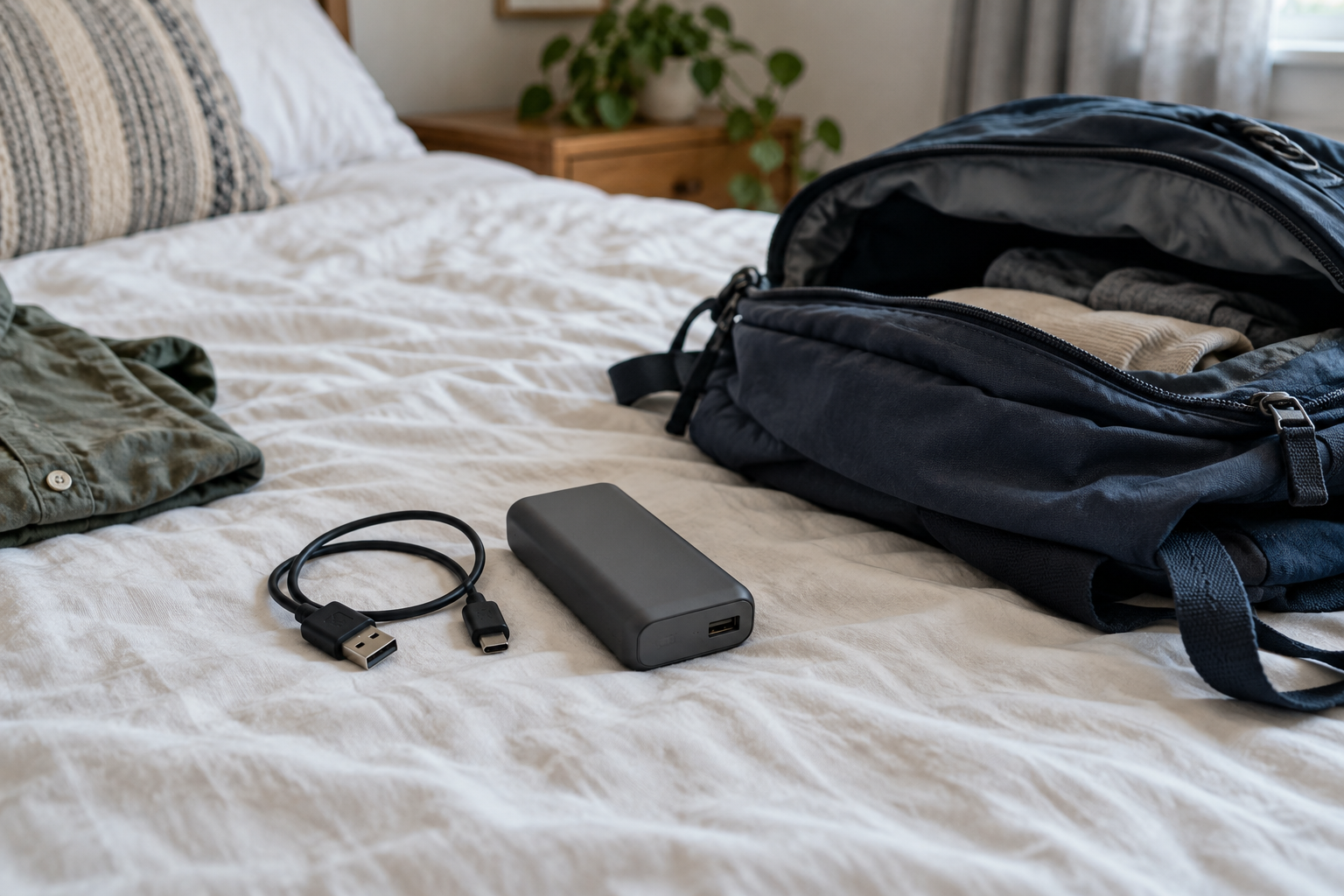
Can you take a power bank on a plane? Four checks before you pack
A power bank can be allowed on your flight but banned from use. Check its capacity, your airline’s allowance and where it must stay before you pack.
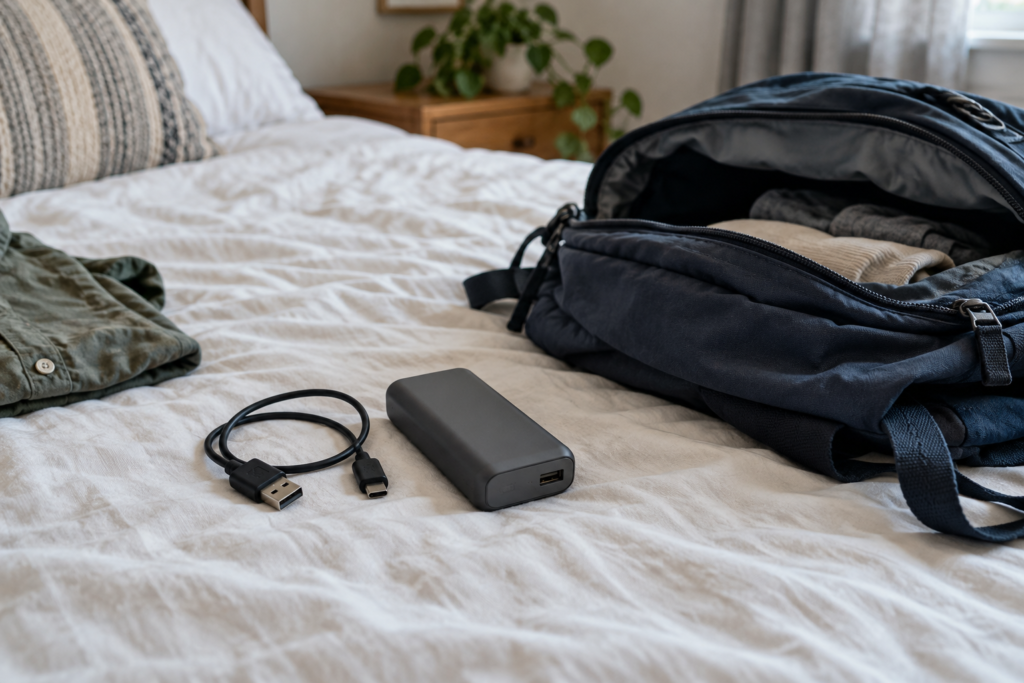
Yes, you can usually take a power bank on a plane, in your cabin baggage. But the battery’s capacity is only one part of the check. Your airline can also limit how many you carry, where you keep them and whether you can use one during the flight.
That last distinction is easy to miss. A charger can be allowed on board and still be off-limits when your phone starts running low.
Rules checked on October 7, 2026. This guide covers ordinary portable power banks for personal electronics; medical equipment needs its own airline arrangements.
1. Read the capacity label, not just the charging wattage
Look for the battery’s watt-hour rating, written as Wh. A large “65W” or “100W” on the box describes charging power, not how much energy the battery stores. It does not establish whether the power bank meets a flight’s capacity limit.
The FAA’s battery guidance explains the calculation: watt-hours equal amp-hours multiplied by voltage. If capacity is given in milliamp-hours, divide by 1,000 first.
Wh = mAh × V ÷ 1,000
For example, a battery specified as 20,000mAh at 3.7V works out to 74Wh. These are illustrative calculations, not approvals for particular products:
| Battery capacity at 3.7V | Calculated energy |
|---|---|
| 10,000mAh | 37Wh |
| 20,000mAh | 74Wh |
| 30,000mAh | 111Wh |
Use the voltage specified for that battery capacity, not a USB output setting. If the label already gives Wh, start there. If the markings are missing or unclear, ask the manufacturer and airline before travelling; a calculation on your phone is not a promise that staff will accept an unmarked device.
For a straightforward purchase, a clearly labelled model below 100Wh is the sensible place to start. It still needs to meet the rules of your particular journey.
2. Check the airline operating each flight
The UK Civil Aviation Authority’s explanation of the March 2026 changes sets out a maximum of two power banks per person, cabin carriage and individual protection against short circuits. It also distinguishes between recharging the power bank, which is prohibited on board, and using it to charge another device, which the guidance recommends against.
Airlines can go further. These two examples show why a generic packing list is not enough:
| Airline | Ordinary power-bank allowance | Use and storage on board |
|---|---|---|
| SWISS | Up to two; up to 100Wh each without prior approval. Above 100Wh and up to 160Wh requires airline approval. | Do not use or recharge them. No overhead-bin storage; keep them in an allowed accessible location, such as under the seat or in the seat pocket. |
| Southwest | One per customer, no more than 100Wh. | It must remain visible when used. Do not recharge it from in-seat power or put it in an overhead bin; store it in your under-seat personal item. |
Both require power banks to stay out of checked luggage. These are examples, not a complete worldwide airline list.
Check the carrier named after “operated by” on every segment, including the return journey. For a connection involving different airlines, choose a packing arrangement that meets each carrier’s requirements. Two permitted on your first flight does not help if the next carrier allows only one.
Be especially careful above 100Wh. The CAA describes an approval route up to 160Wh, while IATA’s 2026 operator guidance discusses tighter treatment and differences in how international changes are adopted. Do not treat an approval allowance for spare batteries as automatic permission for a large power bank. Ask your operating airline about the exact model before packing it.
3. Keep it with you if your cabin bag goes into the hold
A last-minute request to check your bag changes what you need to do. Remove the power bank before handing the bag over and keep it in the cabin.
Pack it so its terminals cannot short-circuit against other objects. Suitable original packaging or a separate protective pouch can help; follow your airline’s instructions. Keep it away from loose keys and coins, and protect it from being crushed.
“In my carry-on” also does not necessarily mean “in the overhead locker.” Check the airline’s storage rule before putting your bag away, so you do not have to retrieve it after settling into your seat.
4. Plan your charging before boarding
Charge your phone and other essentials before you leave. Download your entertainment and keep travel documents available offline where possible. A power bank may still be useful at your destination even when you cannot use it during the flight.
If your airline permits onboard use, follow its visibility and storage instructions. If it prohibits use, leave the charger disconnected. Ask the crew if the instructions on board are unclear.
Leave a damaged or swollen power bank out of your travel kit, and check any manufacturer safety recall affecting your model. If a battery becomes unusually hot, expands or starts smoking on board, notify the cabin crew immediately.
For a Europe trip, battery packing is a separate check from EES, ETIAS and UK ETA requirements. Keep both on your pre-departure list.
Before zipping up, you should be able to answer four questions: What is its Wh rating? How many does each airline allow? Where must it stay? Can I use it? Save the relevant airline page with your booking and check it again before departure. That is more useful than relying on an “airline-approved” claim on a product listing.
Smarter choices start with clearer information.
MASEVIO researches, compares and explains products, technology and emerging ideas to help make everyday decisions easier to understand.
MASEVIO may use affiliate links in some articles. If you buy through an eligible link, MASEVIO may earn a commission at no additional cost to you. Editorial opinions are not determined by affiliate partnerships.

Make every day smarter.
Discover what matters now — useful ideas, standout products, clearer comparisons and stories worth knowing.