
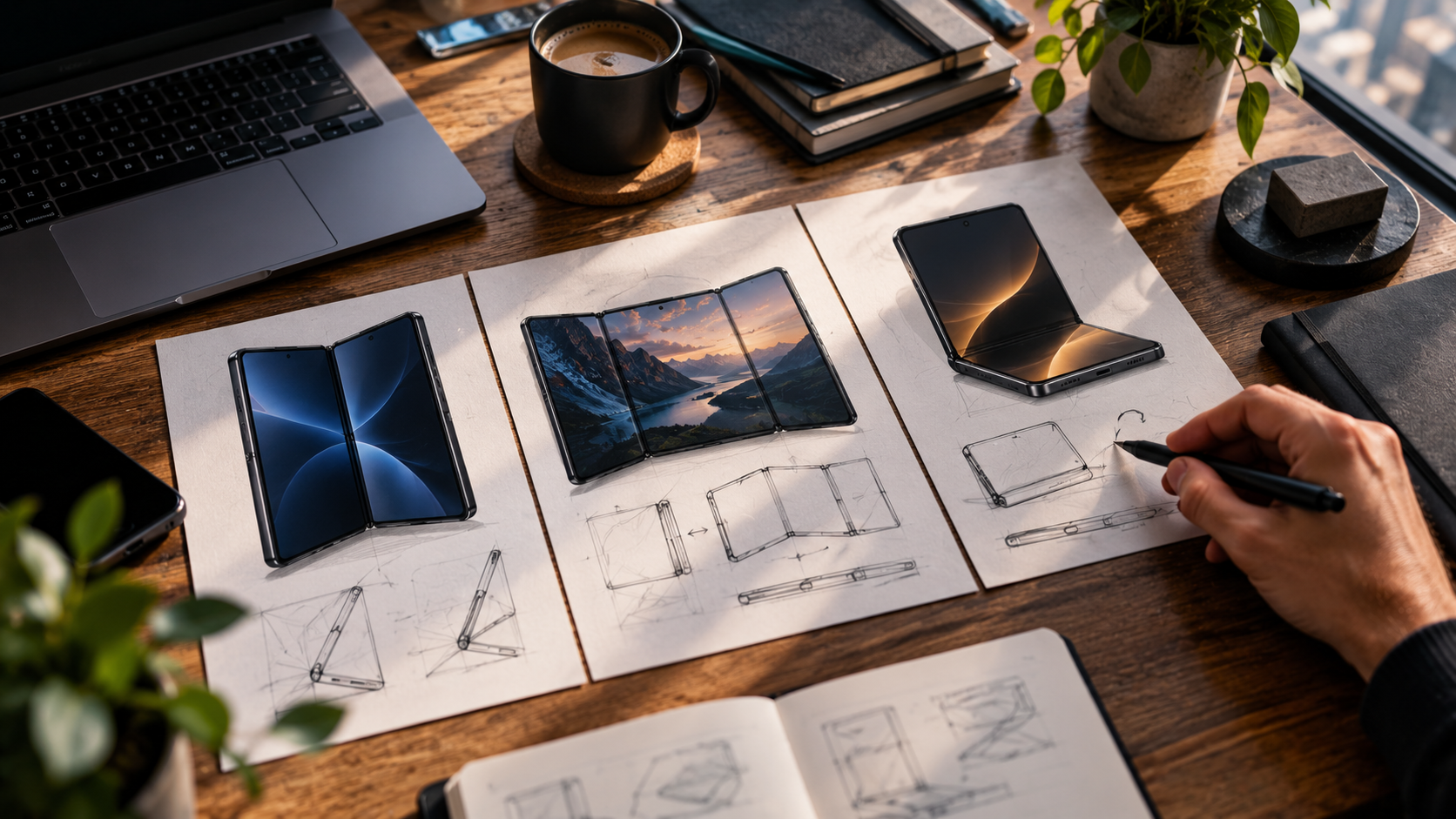
iPhone Duo vs Huawei Mate XT 2 vs Xiaomi 18 Fold: Three Very Different Visions of the Foldable Phone
Apple, Huawei and Xiaomi are taking three very different approaches to foldable phones. We compare the iPhone Duo, Mate XT2 and Xiaomi 18 Fold — and what each says about the future of the category.

The foldable phone market just became much more interesting.
iPhone Duo vs Mate XT2 vs Xiaomi 18 Fold is more than a comparison of three expensive phones. Each represents a different answer to the same question: what should a premium foldable actually be?
The result is not simply a battle between three expensive smartphones.
It is a clash between three different ideas.
Apple is trying to make the foldable feel familiar. Huawei is pushing the format toward a tablet with its tri-fold Mate XT2. Xiaomi, meanwhile, is betting on performance and multitasking with the 18 Fold.
So which approach makes the most sense?
iPhone Duo: Apple wants to make the foldable feel normal
Apple waited while rivals spent years experimenting with foldable screens. With the iPhone Duo, it is finally entering the market — but not with the most radical design.
That appears to be the point.
The Duo uses a 5.4-inch outer display and opens to reveal a 7.6-inch inner display. Apple says both screens use the same aspect ratio, helping apps and content transition more naturally as the phone moves between folded and unfolded modes.
Inside is Apple’s A20 Pro chip, while the larger display is designed around multitasking, entertainment and productivity.
The interesting part isn’t simply the hardware.
Apple’s advantage could be the ecosystem surrounding it.
A foldable iPhone does not have to persuade existing iPhone owners to switch platforms. Instead, Apple has to convince them that a larger, flexible iPhone is useful enough to justify the additional cost.
And that cost is significant.
The iPhone Duo starts at $1,999 in the United States, placing it firmly in ultra-premium territory.
That makes Apple’s first challenge surprisingly simple: proving why somebody needs one.
Huawei Mate XT2: when two screens aren’t enough
Huawei is taking almost the opposite approach.
Instead of making the foldable concept feel conservative, the Mate XT2 pushes it further.
Its tri-fold design uses two hinges, allowing the device to unfold twice and expand toward a tablet-sized experience. It is a fundamentally different proposition from a conventional book-style foldable.
Huawei has also equipped the Mate XT2 with its Kirin 9050 Pro processor, a redesigned hinge, improved water resistance and a privacy-focused display feature designed to reduce visibility from side angles.
But ambitious hardware comes with an ambitious price.
The Mate XT2 range starts at 19,999 yuan in China and rises to 24,999 yuan for the top configuration.
This isn’t Huawei trying to make foldables affordable.
It is Huawei trying to demonstrate how far the format can go.
For users who want maximum screen flexibility from a device that can still fold down for carrying, that philosophy has obvious appeal. The trade-off is complexity, price and the practical compromises that inevitably come with more moving parts.
Xiaomi 18 Fold: performance enters the argument
Xiaomi’s 18 Fold takes another route.
Rather than competing directly with Huawei’s tri-fold spectacle, Xiaomi is emphasizing performance and multitasking.
The phone uses Xiaomi’s in-house XRing O3 processor and LPDDR6 memory supplied by Chinese memory manufacturer CXMT. It also supports using multiple applications on its expanded display.
That matters because it points toward one of the most convincing reasons for owning a foldable in the first place.
A bigger screen is useful only if the software can actually take advantage of it.
Xiaomi is therefore positioning the 18 Fold less as a technological demonstration and more as a high-performance mobile workspace.
Standard configurations start at 10,999 yuan and rise to 14,999 yuan, with a more expensive special edition also offered.
It is still a premium device, but its positioning is notably different from Huawei’s more extreme hardware experiment.
iPhone Duo vs Mate XT2 vs Xiaomi 18 Fold: the real differences
Looking only at specifications misses the bigger story.
These phones represent three strategies for the future of mobile computing.
iPhone Duo: ecosystem and usability first. Apple wants a foldable that behaves like an iPhone before it behaves like an experiment.
Huawei Mate XT2: maximum hardware flexibility. Huawei is willing to make the device more complex in exchange for a much larger transforming display.
Xiaomi 18 Fold: performance and multitasking. Xiaomi is concentrating on what users can actually do with the extra screen space.
None of those approaches is automatically superior.
They simply target different priorities.
The biggest problem with foldables hasn’t disappeared
There is another question manufacturers still need to answer: why should most people replace a conventional flagship phone with a foldable?
Despite years of development, foldables remain a relatively small part of the global smartphone market.
The reasons are familiar.
They tend to cost more. Their folding mechanisms introduce additional engineering challenges. Cameras, battery life and durability have historically involved compromises compared with similarly priced conventional flagships.
The technology has improved substantially, but the value proposition still matters.
Apple entering the market could change that equation.
The company has repeatedly entered established product categories after competitors and then attempted to simplify the experience for a much larger audience.
But the Apple logo alone doesn’t eliminate the fundamental question surrounding a $1,999 folding phone:
What can it do that makes the extra cost worthwhile?
Which one makes the most sense?
For existing Apple users who want a foldable without leaving the iPhone ecosystem, the Duo is the obvious candidate.
Huawei’s Mate XT2 is considerably more experimental. Its tri-fold architecture offers the most dramatic transformation of the three and makes the strongest case for replacing a small tablet as well as a phone.
Xiaomi sits somewhere between those philosophies.
The 18 Fold focuses heavily on performance and multi-app use, which may prove more practical than simply pursuing the largest possible folding display.
There is no universal winner here.
And that may actually be the most important development.
Foldables are finally becoming different from one another
The first generations of foldable smartphones were largely demonstrations that flexible displays could work.
The next stage is about deciding what they should actually be used for.
Apple, Huawei and Xiaomi are arriving at different answers.
Apple sees the foldable as an evolution of the smartphone.
Huawei increasingly treats it as a smartphone that can transform into something closer to a tablet.
Xiaomi is exploring the expanded screen as a serious multitasking platform.
That competition is healthier than three manufacturers building essentially the same device.
MASEVIO verdict
The most interesting thing about the iPhone Duo, Huawei Mate XT2 and Xiaomi 18 Fold isn’t which company has the longest specification sheet.
It’s that foldables are beginning to develop distinct identities.
The iPhone Duo may have the strongest opportunity to bring the format to a broader premium audience because Apple already has an enormous ecosystem of users and developers.
Huawei currently makes the bolder hardware statement.
Xiaomi may offer the most interesting middle ground for buyers who care about performance and productivity.
For consumers, however, the smartest move may still be patience.
These devices show where premium smartphones are heading. Whether foldables become the default form of the smartphone — rather than an expensive alternative to it — will depend on whether manufacturers can turn impressive engineering into something people genuinely need every day.
Smarter choices start with clearer information.
MASEVIO researches, compares and explains products, technology and emerging ideas to help make everyday decisions easier to understand.
MASEVIO may use affiliate links in some articles. If you buy through an eligible link, MASEVIO may earn a commission at no additional cost to you. Editorial opinions are not determined by affiliate partnerships.


Make every day smarter.
Discover what matters now — useful ideas, standout products, clearer comparisons and stories worth knowing.